A Dark-Universe Telescope Just Found a New Comet
Euclid was built to map the dark universe, not to hunt comets. In September 2026 its images caught a previously unknown one, now named C/2026 S1 (Euclid).


ESA's Euclid space telescope was built to map the dark universe. While photographing distant galaxies, it found its first previously unknown comet, now officially named C/2026 S1 (Euclid).
What happened
Euclid imaged the comet between 16 and 24 September 2026 in a region called the Euclid Deep Field North. ESA says it was captured in five different fields of view over several days, giving a total of 16 exposures.[1][2]
It was found by Mikko Pöntinen, a PhD student at the University of Helsinki, working with the Euclid Consortium Solar System Objects Science Working Group. Catalogue checks found no match, so the object was reported to the Minor Planet Center. Ground-based telescopes in Switzerland, Austria, Hungary, Romania, Canada, the USA and Hawai'i followed up and confirmed cometary activity.[1][3][6]
The Minor Planet Center confirmed it as a comet on 8 October 2026, in MPEC 2026-T146. ESA announced the discovery on 19 Oct 2026.[1][2]
Why it's surprising
Euclid is designed to study dark matter and dark energy by observing billions of galaxies out to 10 billion light-years, across more than a third of the sky. For that work, objects inside our Solar System are usually just clutter.[4]
ESA says Euclid deliberately avoids the asteroid- and comet-rich band of sky along the Solar System's plane. Its survey usually visits each patch of sky only once, so it cannot simply go back to a comet. This one lies far above the plane of the planets.[1]
Bruno Altieri of ESA said very few comets are expected to be discovered by Euclid, calling the find "a happy coincidence" of the comet's orbit and Euclid's scanning.[1]
How it was spotted
Euclid takes several exposures of the same patch of sky, minutes apart. Distant galaxies stay fixed between frames. Anything nearby, in our own Solar System, moves.[1]
The detection came from Euclid's visible imager. An ESA animation shows three exposures from 17 Sept 2026, about 17 minutes apart, in which the comet appears as a streak with a fuzzy coma against fixed stars and galaxies.[5]
Moving-object detection software developed by Pöntinen flagged a streak smeared across several images. Pöntinen then predicted the object's position and found it in five image sets.[1][3]
Why it matters
The comet is about 1.3 billion km from Earth, between the orbits of Jupiter and Saturn, on a path that rises far above the plane of the planets.[1][2]
ESA says this comet is not a suitable target for its Comet Interceptor mission. ESA suggests the quick find-and-confirm process means Euclid could spot future comets far from the Sun that might become suitable targets. That is ESA's own assessment.[1]
Our readOur reading: a survey built for the distant universe can still find new objects close to home. What counts as noise in one dataset can be the discovery in another.[1][4]
What's confirmed and what isn't
Confirmed: the designation C/2026 S1 (Euclid), the Minor Planet Center confirmation on 8 October 2026, the September imaging dates, and the comet's approximate distance and steep path above the planets.[1][2]
Still uncertain: the comet's orbit is still being refined, and ESA has not given a size.[1][2]
Early figures for how long the orbit takes are preliminary, so this article does not quote one. It also makes no claims about how bright the comet is.
- Not claimedThe discovery was not described as accidental; ESA calls it a 'happy coincidence', and it was made with dedicated moving-object software.
- Not claimedEuclid was not hunting comets; it deliberately avoids the comet-rich band of sky.
- Not claimedNo size of the comet is claimed; ESA has not given one.
- Not claimedNo brightness claim is made, and the article does not say the comet can be seen by the public.
- Not claimedNo orbital period figure is quoted, because the orbit is still being refined.
- Not claimedThe comet is not claimed to be heading toward Earth.
- Not claimedThe comet is not a Comet Interceptor target.
Sources
- ESA — Euclid discovers new comet, 2026-10-19Primary
- IAU Minor Planet Center — C/2026 S1 (Euclid) object record, 2026-10-08Independent
- Universe Today — ESA's Euclid space telescope has discovered a new comet, 2026-10-19Independent
- ESA — Euclid overviewPrimary
- ESA — Comet C/2026 S1 (Euclid) streaks across the sky, 2026-10-19Primary
- INAF (Istituto Nazionale di Astrofisica) Media — Una cometa per Euclid, 2026-10-19Independent
15 claims checked against these sources; 10 confirmed.
Spot an error? Request a correction.
Video transcript
A space telescope built to map the dark universe has found a brand-new comet.
Euclid photographs galaxies billions of light-years away. Nearby objects are usually just clutter.
But it takes several exposures of the same patch of sky, minutes apart. Galaxies stay put. Anything nearby moves.
In September, a PhD student in Helsinki, using moving-object software, spotted a fuzzy smudge shifting between frames.
Telescopes on the ground followed up, and on October eighth, the Minor Planet Center confirmed it as a new comet.
It's about 1.3 billion kilometers away, between the orbits of Jupiter and Saturn, on a path that climbs steeply above the planets.
Euclid steers clear of the band of sky where most comets are. This one was far above it.
A survey of the distant universe, photobombed by a visitor from next door.
Production note: All visuals in the video are original programmatic illustrations, not Euclid or ESA images. The narration is a synthetic voice, and the music and sound effects were generated in code.
What else changed
 Space & Science2 min readNº 010One Particle of Antimatter, Held for MonthsPhysicists at Northwestern University have held a single positron, the electron's antimatter twin, in a magnetic trap for months. They can now watch it climb one energy step at a time.Read story
 Space & Science2 min readNº 007Moon Trash Could Become Tomorrow's Spare PartsAn MIT student team won first prize in NASA's LunaRecycle Challenge with a system that grinds discarded packaging and molds it into composite parts. The foam usually thrown out becomes part of the material.Read story
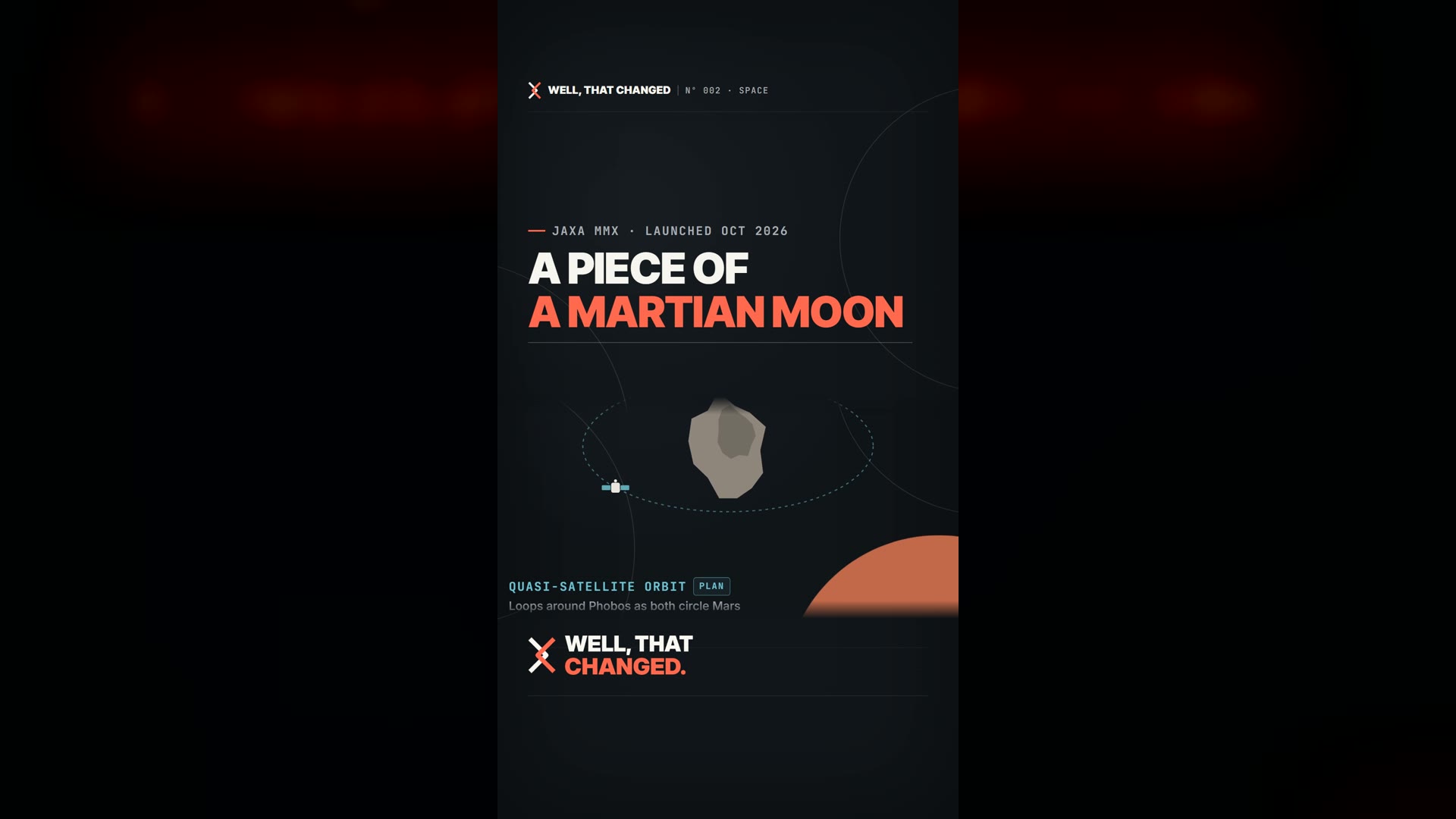 Space & Science2 min readNº 002Japan Is Going to Mars's Moon Phobos — and Plans to Bring a Piece BackJAXA's MMX spacecraft has launched toward Phobos, one of Mars's two moons. The plan is to bring at least 10 grams of it back to Earth by 2031.Read story