Japan Is Going to Mars's Moon Phobos — and Plans to Bring a Piece Back
JAXA's MMX spacecraft has launched toward Phobos, one of Mars's two moons. The plan is to bring at least 10 grams of it back to Earth by 2031.

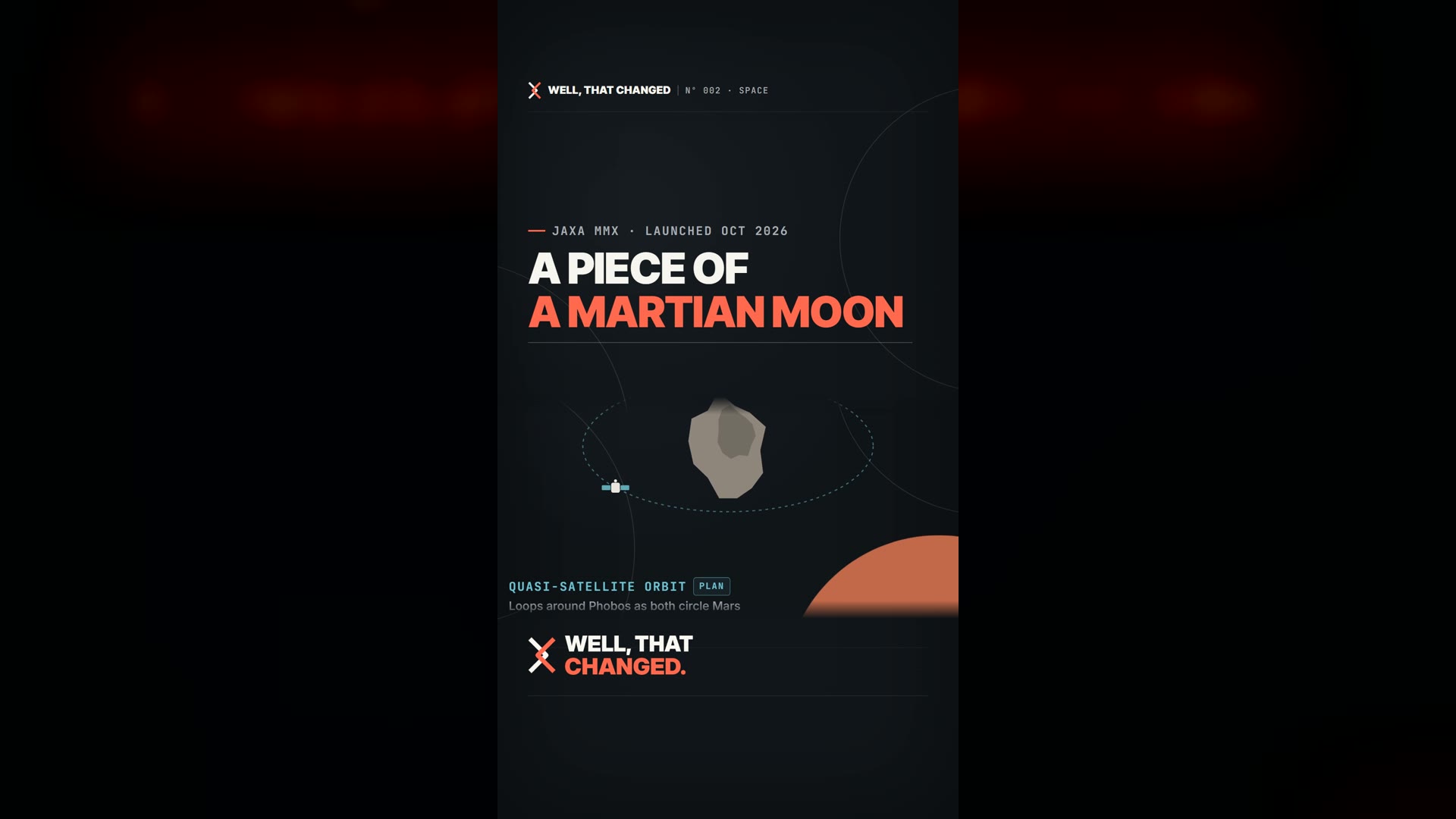
Japan's space agency JAXA has launched a spacecraft to Phobos, the larger of Mars's two moons. The mission aims to return at least 10 grams of Phobos material to Earth.
What happened
The mission is called MMX, short for Martian Moons eXploration. It launched on 20 October 2026 at 04:41 JST (19:41 UTC on 19 Oct) on H3 rocket Flight No. 10 from Tanegashima Space Center in Japan.[2][3]
JAXA says that, as of 21 Oct 2026, the first critical operations phase is complete. According to the agency, the solar arrays have deployed, the spacecraft has a stable three-axis orientation, an antenna restraint has been released, and the spacecraft is healthy.[1]
Launch is the only step so far. Everything after it is still a plan.
It has been tried before
MMX is not the first attempt at a Phobos sample return. Russia's Phobos-Grunt launched on 8 Nov 2011 to bring back a sample of Phobos. It reached Earth orbit, but its engines never fired to send it toward Mars. It fell back into the atmosphere on 15 Jan 2012.[4]
JAXA describes MMX as the world's first mission to return material from the Martian sphere. That depends on the mission succeeding.[2][7]
Our readSo MMX is better described as aiming to be the first mission to succeed, not the first to try.[4][2]
How the mission should work
The plan is for MMX to arrive at Mars in 2027. ESA's timeline gives August 2027 for arrival and September 2027 for entering orbit around Phobos.[5][7]
The spacecraft would then study Phobos from a looping path called a quasi-satellite orbit, mapping it from close range during 2027-2030. Two landings are planned. The mission also plans to observe Deimos, Mars's other moon.[5][7]
Sampling is planned for no earlier than 2028, using two tools. JAXA's coring sampler, the C-Sampler, is designed to reach a few centimetres below the surface. A NASA-funded pneumatic sampler, the P-Sampler, built by Honeybee Robotics, sits on a landing leg and uses bursts of high-pressure nitrogen gas.[6]
The plan is for MMX to leave the Mars system in 2030. A capsule carrying the sample would then land in Australia in 2031.[5]
Why it matters
Scientists do not know how Phobos and Deimos formed. They may be asteroids that Mars captured, or debris from a giant impact on Mars. Samples could help decide between the two ideas.[6][8]
Our readA few grams of material studied in labs on Earth could tell scientists more about this question than observation from a distance. Even so, the answer is still years away and depends on every planned step working.[5][6]
What's confirmed and what isn't
Confirmed: MMX launched on 20 October 2026 on an H3 rocket from Tanegashima. JAXA reports that the spacecraft is healthy and its initial critical operations are complete.[2][3][1]
Planned, not done: arrival at Mars in 2027, the landings, sampling no earlier than 2028, and the capsule's return to Australia in 2031. The goal of at least 10 grams is a target, not a result.[5][7][6]
Nothing has been sampled yet. MMX is designed to sample Phobos, a moon of Mars, not Mars itself.
- Not claimedMMX does not sample Mars itself; it is designed to sample Phobos, one of Mars's moons.
- Not claimedNothing has been sampled or returned yet; every step after launch is a plan.
- Not claimedMMX is not the first attempt at a Phobos sample return; Phobos-Grunt tried in 2011. MMX aims to be the first to succeed.
- Not claimedMMX does not land on Mars; the planned landings are on Phobos.
- Not claimedThe story does not claim that a Phobos sample would contain pieces of Mars.
- Not claimedThe story does not settle whether Mars's moons are captured asteroids or impact debris.
Sources
- JAXA — End of MMX initial critical operations phase (MMX launch / initial operations press release, Japanese), 2026-10-21Primary
- JAXA ISAS — Martian Moons eXploration (MMX)Primary
- ESA — MMX lifts off to Mars's moon Phobos, 2026-10-20Independent
- SpacePolicyOnline — ESA confirms Phobos-Grunt reentry locationIndependent
- JAXA MMX project — MMX - Martian Moons eXplorationPrimary
- NASA Science — NASA to Help Unlock Mysteries of Mars' Moons in Upcoming Mission, 2026-10-15Independent
- ESA — MMX from launch to Phobos, 2026-10-13Independent
- DLR — MMX mission successfully launched - Idefix rover on its way to Martian moon Phobos, 2026-10-19Independent
8 claims checked against these sources; 3 confirmed.
Spot an error? Request a correction.
Video transcript
Japan has launched a spacecraft to one of Mars's moons, and it plans to bring a piece of it home.
It's called MMX. It launched on an H3 rocket on October twentieth, Japan time, and JAXA says it's healthy.
It should reach Mars next year.
Then it will fly a looping orbit around Phobos, mapping it from close range.
Around 2028, it plans to land, and push sampling tools a few centimeters into the surface. The target is at least ten grams.
Why Phobos? No one knows if Mars's moons are captured asteroids, or debris from a giant impact. A sample could tell.
The sample capsule should land in Australia in 2031. Russia tried this in 2011, and failed.
Ten grams of moon dust could answer a very old question. Well, that changed things.
Production note: All visuals in the video are original programmatic illustrations, not JAXA imagery or footage. The narration is a synthetic voice, and the music and sound effects were generated in code.
What else changed
 Space & Science2 min readNº 010One Particle of Antimatter, Held for MonthsPhysicists at Northwestern University have held a single positron, the electron's antimatter twin, in a magnetic trap for months. They can now watch it climb one energy step at a time.Read story
 Space & Science2 min readNº 007Moon Trash Could Become Tomorrow's Spare PartsAn MIT student team won first prize in NASA's LunaRecycle Challenge with a system that grinds discarded packaging and molds it into composite parts. The foam usually thrown out becomes part of the material.Read story
 Space & Science2 min readNº 003A Dark-Universe Telescope Just Found a New CometEuclid was built to map the dark universe, not to hunt comets. In September 2026 its images caught a previously unknown one, now named C/2026 S1 (Euclid).Read story